-
News | Real Estate
UAE Real Estate 2025: Off-Plan Surge & Luxury Homes Rise
End of 2025, the UAE property market will be at a turning point, where growth will continue. Across Dubai and Abu Dhabi, developers are introducing new projects that are shaping both the skyline and lifestyle. Off-plan sales continue to drive growth, while ready to move properties meet steady end-user demand. These trends together demonstrate how the UAE is evolving into one of the most promising real estate markets in the world.
The Rise of Off-Plan Dominance
Dubai’s property market once again proved its strength in the third quarter of 2025. Off-plan transactions accounted for more than three-quarters of total property sales in the same period in 2024. This marks a sharp rise of over 26 per cent compared to the same period last year. The total value of these transactions reached AED 96 billion, while overall property sales stood at AED 134 billion.
This level of activity signals more than short-term excitement. It reflects strong investor confidence in Dubai’s future. Developers have successfully created new value through flexible payment options, limited-time pricing, and commission incentives for agents. Together, these factors encourage both domestic and international buyers to secure property early in the development cycle.
Even before construction is complete, off-plan properties have become an entry point for investors seeking high ROI in prime areas. Low initial costs and capital appreciation make these projects a viable option for long-term investments.
Apartments Lead, but Villas Define Luxury
Apartment sales continue to dominate Dubai’s off-plan landscape. Locations like Jumeirah Village Circle and Business Bay attract investors due to their good rental prices and accessibility. Their appeal lies in modern, compact living spaces that appeal to both young professionals and global investors.
On the other hand, waterfront developments are setting price benchmarks. Areas such as La Mer, Jumeirah, and Dubai Water Canal consistently record some of the highest average prices per square foot. These properties offer something beyond address value — proximity to water, design, and privacy — which together command a premium.
Industry leaders note that this momentum underscores Dubai’s maturity as a market. Investors now see the city as a stable, long-term base, not just a speculative opportunity.
Ready Homes Continue to Hold Their Ground
Off-plan projects may dominate headlines, but Dubai’s resale market continues to hold strong appeal. In Q3 2025, 84 percent of resale transactions were for completed homes, while only 16 percent involved off-plan resales. The numbers show a clear pattern — most buyers still prefer ready properties for immediate move-in and long-term stability.
Even with a slight decline in the total number of resale transactions, prices rose by 11.3 per cent to reach an average of AED 1,656 per square foot. Ready villas remain the most sought-after. Nearly all villa resales this quarter were for completed homes.
Communities such as Palm Jumeirah, Arabian Ranches 3, and The Springs led the performance charts. Palm Jumeirah saw resale prices rise nearly 19 per cent, while Arabian Ranches 3 grew by 20 per cent. Apartments in Town Square jumped by more than 25 per cent, showing that mid-market communities are now benefiting from the city’s broader demand wave.
These numbers underscore a precise market segmentation. Investors look to off-plan opportunities for future growth, while end-users value ready homes for convenience and immediate occupancy. Both forces are keeping the market active from different ends.
Rental Market Stays Steady
Dubai’s rental market continues to reflect balance and strength. Average rental rates rose nearly 9 per cent over the past year, reaching AED 83 per square foot. While total rental transactions dipped slightly, analysts attribute this to longer lease terms and better tenant retention.
The combination of rising rents, stable returns, and low vacancy rates reinforces Dubai’s reputation as a landlord-friendly city. For many investors, rental yields remain among the strongest in global urban markets, particularly for mid-segment apartments.
The Return of Waterfront Grandeur
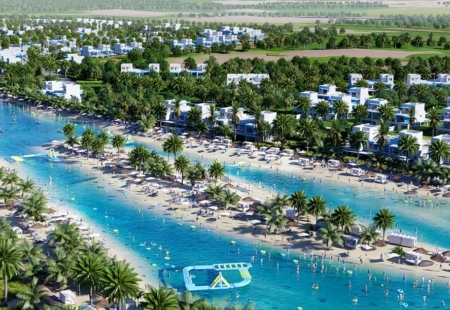
Few places define Dubai’s ambition like Palm Jebel Ali. The master developer Nakheel has reintroduced the island with an updated plan featuring 16 fronds and over 90 kilometres of coastline. Its new release includes a collection of high-end villas across The Beach and The Coral Collections.
The Beach Collection features five- and six-bedroom villas ranging between 7,500 and 8,500 square feet. Each home has direct beach access and distinctive architecture. The Coral Collection offers larger six- and seven-bedroom villas that extend up to 12,500 square feet. Each villa follows an individual design concept, combining architectural precision with beachfront living.
The development also includes a 9,000-square-metre retail hub and a mosque, designed by Skidmore, Owings & Merrill, accommodating 1,000 worshippers. Palm Jebel Ali’s revival aligns with Dubai’s long-term urban strategy outlined in the 2040 Master Plan. The island is expected to become a symbol of sustainable coastal development is a place where residential, retail and leisure spaces blend seamlessly.
Abu Dhabi’s Cultural Statement: The Row Saadiyat
While Dubai expands its coastline, Abu Dhabi is shaping its cultural heart. Aldar Development has announced The Row Saadiyat is a boutique residential quarter in the Saadiyat Cultural District.
The development comprises seven mid-rise buildings, each with nine floors. Apartments range from one to three bedrooms and are designed by the award-winning firm Kettle Collective. The ground floors feature cafes, wellness spaces, and lifestyle outlets that connect residents with the district’s artistic environment.
Located near the Louvre Abu Dhabi and the upcoming Guggenheim, The Row Saadiyat positions itself as a blend of culture and comfort. Aldar’s design approach focuses on creating modern living within walking distance of world-class museums and galleries.
“The Row Saadiyat brings together the essence of place and design,” said Jonathan Emery, CEO of Aldar Development. “It reflects the city’s evolution into a global cultural capital.”
Abu Dhabi’s vision for Saadiyat Island continues to move toward creating integrated communities where lifestyle and heritage coexist.
The World Islands Reimagined
Innovation continues offshore, too. Dubai is set to introduce the region’s first Buddha-Bar Hotel and Floating Residences on The World Islands. The AED 3 billion project blends hospitality with experiential design.
The development will include 162 hotel rooms, 24 floating residences, and the signature Buddha-Bar Beach. Each residence spans around 4,000 square feet across three levels — with rooftop decks, sea-level lounges, and underwater bedrooms with coral views.
The interiors can be furnished with Bentley Home collections, emphasizing craftsmanship and comfort. This project is more than a luxury retreat. It represents Dubai’s growing interest in experiential real estate — spaces that merge art, architecture and hospitality.
Scheduled for completion in 2027, the project expands Dubai’s appeal to global investors looking for distinct, limited-edition properties with strong long-term potential.
Emaar Hills: A New Landmark of Refinement
Back on the mainland, Emaar continues to shape Dubai’s high-end living scene with Emaar Hills – a AED 100 billion master development anchored by the newly launched Dubai Mansions.
These residences redefine what urban luxury means in the city. Each mansion, ranging from 10,000 to 20,000 square feet, is designed for privacy, proportion and elegance. The community integrates golf courses, wellness facilities, landscaped parks, and retail destinations, forming a complete living environment.
Located close to Dubai Hills Estate and Dubai Hills Mall, residents enjoy easy access to both leisure and essential amenities.
“Emaar Dubai Mansions represents the finest form of luxury living,” said Mohamed Alabbar, Founder of Emaar Properties. “Every home and every garden reflects care and precision.”
Emaar Hills embodies Dubai’s next stage of development – self-contained, sustainable, and refined communities that appeal to global citizens seeking security and sophistication.
A Market Built on Confidence
The combined impact of these projects tells a larger story – one of balance, variety, and resilience. Off-plan properties are fueling growth and innovation, while ready homes maintain stable demand. Waterfront developments are expanding the city’s global identity, and boutique communities are redefining urban life in Abu Dhabi.
Investors continue to see the UAE as a safe and rewarding destination for long-term capital. A clear legal framework, investor protection measures and transparent transaction systems have helped maintain that trust.
Dubai’s open visa programs and global connectivity continue to attract high-net-worth individuals and corporate investors alike. Meanwhile, Abu Dhabi’s cultural initiatives and infrastructure investments add depth and diversity to the national property landscape.
The Outlook Ahead
Market experts expect the UAE real estate sector to maintain its steady climb through 2026. The focus is now shifting towards premium waterfront projects, branded residences and lifestyle-based communities. Developers are also aligning with sustainability goals through green building standards and the integration of renewable energy.
According to market expert, several countries in Europe, India and the GCC remain strong, driven by currency stability and investor-friendly policies. In Dubai, areas such as Dubai South, MBR City, and Dubai Hills are gaining traction. In Abu Dhabi, Saadiyat and Yas Island remain the top draws for both end-users and investors.
The market’s ability to accommodate both investor speculation and end-user demand keeps it balanced. It is this diversity from penthouses on the water to cultural apartments near museums that makes the UAE property sector uniquely adaptable.
From Nakheel’s modern villas at Palm Jebel Ali to Emaar’s stately mansions at Emaar Hills, the direction is clear. The UAE is not building homes; it is shaping environments where architecture, culture and community evolve together.
Each project tells a part of that larger narrative of a nation where design meets purpose, and every development reflects a broader ambition.
As 2025 draws to a close, the UAE’s real estate market continues to do what it does best: grow with intent, lead with imagination, and deliver with precision.