-
News | Real Estate
Capital Growth: Sheikh Zayed Road and DIFC Commercial Properties
On clear weekdays, the skyline along Sheikh Zayed Road and the Dubai International Financial Centre shows how busy Dubai’s business district is with official and commercial activity.. Office towers rise along the highway. In DIFC, banks and global firms operate from glass buildings set close together. Metro stations connect both areas, moving professionals across the city with ease.
Behind this busy scene lies an important question for investors. Where is capital growth stronger, and why?
Strong Demand and Tight Supply
Dubai’s office market has gained speed again. Recent commercial sales data shows a clear rise in transactions. The main reason is simple. There is not enough prime Grade A office space in central locations.
Companies are expanding. Family offices and financial firms are setting up regional bases. As a result, ready office space in core areas has become limited.
High occupancy levels in top towers support rental stability. When supply stays tight and demand remains steady, prices often move upward. Buyers are now committing earlier in the development cycle to secure space before inventory runs out.
This shortage is not short term. New supply in central business zones remains controlled. That supports both rental growth and capital appreciation.
AHS Tower Signals Market Confidence
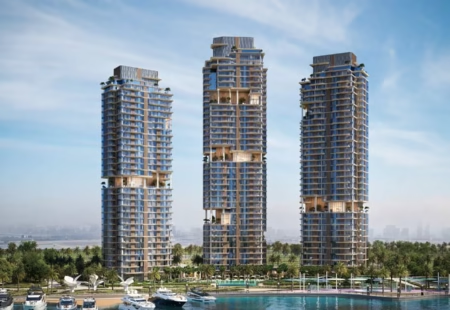
A clear example of strong demand is the sell-out of AHS Tower on Sheikh Zayed Road. The 69-storey commercial tower sold all units during development and generated over USD 700 million in sales.
This performance shows strong investor confidence in central Dubai office space. Buyers were willing to commit before completion because prime large-format office units are limited.
The tower offers half-floor and full-floor units, ranging from about 2,900 to 6,600 square feet. It also provides metro access and executive-level amenities. The quick absorption confirms that quality office assets in strong locations attract capital fast.
When major projects sell out early, it often signals upward pressure on future values.
Institutional Capital Moving Into DIFC
Another major signal came from Aldar Properties, which acquired a prime office tower in DIFC in one of Dubai’s largest recent commercial property deals. The transaction was valued at approximately AED 1.2 billion, or about USD 330 million.
The building is a fully leased Grade A commercial property with multinational tenants under long-term agreements. This deal confirms that institutional investors are increasing exposure to core financial districts.
Large-scale acquisitions by listed developers show confidence in long-term rental income and capital preservation. Institutional capital often focuses on stable income streams and scarcity-driven value. DIFC fits that profile due to limited land and strong tenant demand.
When major developers deploy capital into a district, it strengthens market perception and supports price stability.
Sheikh Zayed Road: Flexible Entry and Growth Opportunity
Sheikh Zayed Road runs through Dubai’s main commercial corridor. It connects Downtown, Business Bay, DIFC and other business districts. It also offers strong visibility and direct metro links.
This corridor includes a mix of older towers and new Grade A buildings. Because of this variety, entry pricing is wider than DIFC. Investors can enter at moderate levels in some buildings while prime towers command higher prices.
During market upswings, assets purchased at moderate price points often show stronger percentage growth. When demand rises across the district, upgraded and well-located towers benefit first.
In recent cycles, limited prime supply has pushed buyers toward Sheikh Zayed Road, especially near DIFC and metro stations. That demand supports capital growth potential.
Dubai International Financial Centre: Scarcity and Long-Term Stability
Dubai International Financial Centre operates as a financial free zone with its own legal system. It hosts global banks, asset managers, and law firms. Its environment attracts multinational tenants who value structure and regulation.
Because land is limited, office supply inside DIFC is controlled. Scarcity supports pricing. Entry costs are usually higher compared with Sheikh Zayed Road.
Higher pricing can limit short-term percentage growth. However, it often provides capital protection. Corporate tenants in DIFC tend to sign longer leases. Institutional demand remains strong. This reduces vacancy risk.
For investors who focus on steady performance and lower volatility, Dubai International Financial Centre offers consistency.
Rental Trends Support Capital Growth
Rental income is closely linked to capital value. When rents stay strong, property values often rise.
Both Sheikh Zayed Road and DIFC have seen stable rental performance due to limited supply. Occupancy in premium towers remains high. Corporate relocations to Dubai continue to support demand.
Dubai’s commercial rental yields remain competitive when compared with many global cities. This income advantage strengthens investor appeal.
Prime corridors such as DIFC and Sheikh Zayed Road lead this performance because businesses prefer central locations.
Market Risks and Supply Watch
Commercial property responds to economic cycles. Interest rates, global growth, and corporate expansion can influence office demand.
Future supply also matters. While current prime stock is limited, new developments and refurbished buildings may enter the market over time. Investors should monitor pipeline data and vacancy trends carefully.
Core business districts usually show stronger resilience than secondary locations. However, asset quality still matters. Not all buildings perform equally within the same corridor.
What Investors Can Expect
Over a 3-to-5-year horizon, capital growth patterns may continue to reflect the core fundamentals of these corridors:
- Dubai International Financial Centre is likely to deliver stable and moderate capital growth. Scarcity, strong tenant demand, and premium corporate presence support resilience.
- Sheikh Zayed Road may show broader growth potential in prime assets, especially those that upgrade older stock or offer large floor plates and direct transport access.
Both corridors are central to Dubai’s wider economic strategy of attracting global firms and boosting foreign direct investment. Their performance will remain linked to overall business confidence, infrastructure expansion, and sustained occupier demand.
The Core Insight
When comparing capital growth between Sheikh Zayed Road and Dubai International Financial Centre commercial properties. The difference is not simply about price. It is about market mechanics, tenant demand, supply constraints and investor strategy. Data shows that limited Grade A office supply is pushing buyers into the market early, and flagship developments such as AHS Tower are selling out before completion because of intense competition for space.
For investors weighing where to allocate capital. the key questions are as below:
- How much premium am I willing to pay for stability?
- How much growth potential do I seek from entry pricing?
- Will rental income support long-term value alongside capital growth?
The future of Dubai’s office market will be shaped by how these corridors balance scarcity, demand, and global corporate interest. When the numbers are placed side by side yield, pricing, take-up and vacancy. The outlook becomes less about speculation and more about clear data-driven choices. Over time, these choices define real returns on commercial property investment.