-
Buying Guide | Real Estate
Binghatti vs. Nakheel Properties Investment Guide (2026) : Which Dubai Developer Reigns Supreme?
The UAE property market in 2026 is expected to be one of the strongest investment destinations in the world. The country’s stable economy and investor-friendly policies is important factor to drive confidence and global attention.
The property market in Dubai showed potential growth throughout 2024 and 2025. The total value of real estate transactions reached AED 761 billion in 2024. It had reflected a 20% annual increase. The momentum carried into 2025, with the first half of the year recording AED 431 billion in transactions. It is a 25% rise compared to the same period last year.
In the first nine months of 2025 in the Dubai Real Estate, Reported over 155,000 real estate transactions with a total value approaching AED 500 billion ($136 billion). For comparison, the same period in 2024 saw around 130,360 transactions worth AED 374 billion. This represents an 18.5% growth in transaction volume and a 33.7% increase in value year-on-year.
According to government data, which includes sales and rent agreements. Dubai recorded 2.78 million total real estate procedures in 2024. Of these, 226,000 were property transactions, which shows how active and liquid the market has become.
A combination of strong local demand, foreign investor participation, and ongoing economic reforms backs this continued growth. Analysts predict that property prices in Dubai will rise by 4% to 6% in 2026, supported by population growth, tourism expansion, and steady demand for off-plan developments.
Among developers, Binghatti Developers stands out as a leading name in 2025. The company sold nearly 12,000 residential units and launched 13 new projects by Binghatti valued at around AED 12.28 billion. Their design-focused approach and partnerships with luxury brands such as Mercedes-Benz and Bugatti continue to attract global buyers who are seeking modern and high-end living.
Meanwhile, Nakheel Properties remains a cornerstone of Dubai’s real estate sector. The developer continues to manage iconic projects, such as the Palm Jumeirah, Deira Islands and Tilal Al Furjan. It reinforces its legacy as a leader in large-scale master-planned communities. Industry data shows Nakheel among the top-performing developers in both sales and value with its projects consistently drawing investor confidence.
Together, these two developers highlight Dubai’s dual strength. Nakheel represents long-term vision and large-scale legacy, while Binghatti reflects innovation and design-driven urban growth. Their combined impact anchors luxury and off-plan segments of the Dubai. Two of the fastest-growing categories in the market.
The data and trends all point in one direction: sustained growth and resilience with strong fundamentals, high investor confidence and consistent developer activity. Dubai’s property market is positioned for another year of expansion in 2026. For international buyers and investors, the window remains open to participate in one of the world’s most dynamic and rewarding real estate markets.
Legacy and Brand Story
Nakheel began operations in 2000 under the umbrella of Dubai World. Over the past 20 years it has reshaped Dubai’s coastline through vast initiatives like Palm Jumeirah, The World Islands and Deira Islands. The developer’s legacy is built on large-scale vision, global appeal and landmark addresses.
Binghatti has founded in 2008 by Muhammad Binghatti. it offers a different path which focuses on vertical-luxury towers with bold design, strong aesthetics and urban energy. With off plan projects in areas like Business Bay and JVC, Binghatti appeals to buyers who value design, detail and brand partnership.
Both brands have proven their strength: Nakheel via scale and renewal, Binghatti via innovation and identity.
Development Philosophy
Nakheel’s philosophy centers on master-planned communities. Each of its developments aims to become self-sufficient by building residence, retail, entertainment and infrastructure. Projects like Palm Jumeirah and Tilal Al Furjan show its ability to shape entire ecosystems of living, leisure and investment value.
Binghatti takes a different route. It delivers signature towers and developments, each with distinct identity. For example, Binghatti Avenue, Binghatti Creek and the future Mercedes-Benz Places in Downtown Dubai. The developer emphasizes design-led living, timely delivery and premium finishes that attract buyers seeking uniqueness.
In short: Nakheel builds destinations. Binghatti builds design-driven residences. Each developer specializes in their work to suit specific investors and lifestyle preferences.
Project Portfolio Comparison
Here is a snapshot of how their projects differ:
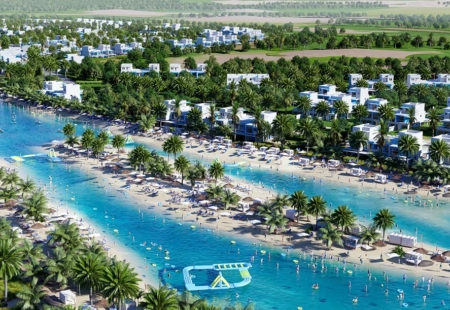
- Nakheel Properties: Waterfront and villa-heavy projects, landmark islands, high premium entry points and strong global recognition.
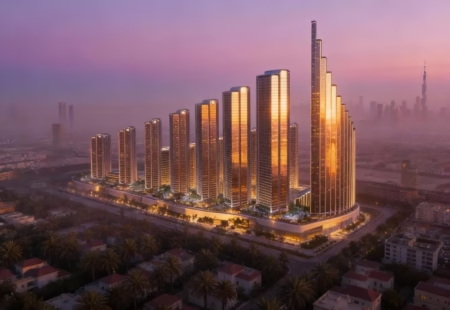
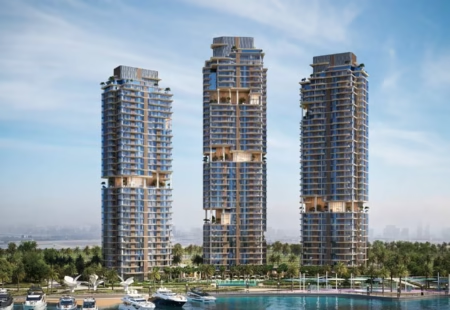
- Binghatti Properties: Urban luxury towers, mid-to-premium entry points, brand partnerships and high-design appeal.
For potential buyers: if you are looking for prestige, large-scale value and long-term capital gain you might lean towards Nakheel. If you prefer stylish urban living, strong design and more flexible entry you might consider Binghatti.
Market Performance and ROI
Nakheel is the leader in Dubai’s villa and waterfront segment properties. On Palm Jumeirah, one-bedroom apartments average around AED 3.3 million and luxury villas around AED 35 million with rental returns of roughly 4 %–6.1 %. Due to the excellent location and strong rental demand in Tilal Al Furjan, villa properties offer rental returns of around 6%.
Binghatti focuses on urban zones like Business Bay, JVC and Al Jaddaf. Their apartments typically range between AED 800,000 and AED 10 million based on location and branding. Rental returns generally sit at 5 %–6 %.
Both developers offer competitive returns. The key difference lies in scale, price-entry and brand dynamics.
Design, Delivery and Sustainability
Design plays an essential role in Binghatti’s approach. Its towers carry strong visual identity, modern facades and bold geometry. Beyond aesthetics, Binghatti emphasizes energy-efficient materials and sustainable construction features.
Nakheel’s focus is infrastructure, landscaping and large-scale sustainability. It installs solar technologies, recycles water and builds large green belts in its communities. Its master plans incorporate transport connectivity, community amenities and future-proof infrastructure.
Though their methods differ, both developers share an emphasis on environmental responsibility. Each developers adapted to their scale and philosophy.
Who Should Invest With Which Developer?
For long-term growth seekers: If you’re an investor aiming at iconic property, strong capital appreciation and global prestige, Nakheel’s coastal mega-developments such as Palm Jumeirah and Deira Islands may suit you best.
For design-and-urban-living seekers: If you favors modern living, direct urban access, design-driven architecture and more accessible entry points, Binghatti’s city-based projects may better choice with your goals.
Final Thoughts
The comparison between Binghatti Developers and Nakheel Properties tells a bigger story. It mirrors Dubai’s real-estate evolution: from grand, large-scale geography-changing projects to sleek, design-forward developments of today.
Nakheel offers heritage, scale and landmark status. Binghatti offers creative architecture, urban convenience and design-luxury. They do not compete to be better; they serve different investor minds and buyer desires.
Choose a developer whose vision matches your investment profile and buying needs.. Whether your goal is grandeur or modern lifestyle, landscape or skyline, legacy or innovation. Dubai’s real-estate market has both ends covered.
2025 and 2026 will offer good opportunities with a clean economy, consistent growth projections and developer reliability. Start your research early to align your goals and show intention in your property investment.