-
Market Insights | Real Estate
Abu Dhabi Property Prices in 2026: Is the Capital Set for a Dubai-Style Boom?
In 2020, few expected Dubai’s property market to surge the way it did after COVID. Prices had dropped. Developers slowed new launches. Buyers were cautious. Then the recovery came fast in Dubai real estate.
Today, many investors are asking a direct question.
Is Abu Dhabi real etate in a similar position now? The numbers suggest strong momentum.
What Happened in Dubai Real Estate After COVID?
In early 2020, Dubai property prices declined when the pandemic began. Buyers paused. Some sold at lower values. Developers delayed launches because demand slowed.
Then conditions changed.
The UAE reopened quickly. Remote work became normal. Many professionals and business owners realized they could operate globally while living in the UAE. Later, geopolitical events and sanctions in Europe pushed capital toward safer regions. Dubai benefited from this shift.
Three factors drove the boom:
- Prices were relatively low
- Supply growth slowed during uncertainty
- Demand surged as global capital relocated
Over the past two years, Dubai recorded over 238,000 off-plan sales. Prices are now significantly higher than pre-2020 levels.
That cycle reshaped the market.
Is Abu Dhabi in a Similar Position Today?
Abu Dhabi’s market in 2025 shows several comparable signals.
Transaction values have doubled over the past four years. The population is nearing 4.3 million. In 2024 alone, population growth reached about 7.5 percent, adding roughly 288,000 residents.
The workforce in key financial areas grew by around 17 percent in a single year.
At the same time, off-plan supply remains limited compared to Dubai. In the last two years, New off-plan Project in Abu Dhabi recorded around 24,300 sales across villas, townhouses, and apartments. That is a fraction of Dubai’s volume.
When demand rises faster than supply, price pressure builds.
Price Gap Between Abu Dhabi and Dubai
One clear difference is pricing.
In prime areas of Dubai, luxury villas and large apartments now trade at high per square foot levels. In Abu Dhabi, similar asset classes remain more accessible.
In key districts such as Al Maryah Island and Saadiyat Island, off-plan pricing still sits below comparable Dubai locations. For example:
- A three-bedroom off-plan unit in the financial district can remain under AED 4 million.
- A six-bedroom villa on a large coastal plot can trade near AED 10 million.
For international investors comparing capital cities, that pricing gap stands out.
Lower entry cost combined with rising demand creates strong upside potential.
Demand Drivers Behind Abu Dhabi’s Growth
Several forces are shaping the capital’s market.
First, global wealth relocation continues. High net worth families from China, Europe and other regions are looking for political stability, tax efficiency, and safety. The UAE ranks high in global safety indexes.
Second, Abu Dhabi is investing heavily in infrastructure and culture. The expansion of Yas Island, growth around Saadiyat Island, and world-class institutions such as the Louvre Abu Dhabi and the upcoming Guggenheim Abu Dhabi strengthen global appeal.
Third, employment growth in finance, energy, and technology supports long-term housing demand.
Rental yields in Abu Dhabi can reach up to 9.7 percent in selected communities. For income-focused investors, that remains attractive compared to many global cities.
Supply Pressure and Future Outlook
One key factor in Dubai’s post-COVID boom was limited supply during the early recovery phase.
Abu Dhabi today faces a similar dynamic. Development remains active, but total new supply volumes are controlled compared to Dubai’s scale.
If population growth continues and new project launches do not accelerate sharply, price appreciation becomes likely.
Investors often move early in such cycles. When prices are still moderate, entry risk is lower. As momentum builds, pricing adjusts faster.
Is Abu Dhabi Growing Faster Than Dubai?
Dubai remains larger in transaction volume and international visibility. However, growth rate matters.
Abu Dhabi’s transaction values doubling in four years shows strong acceleration. Workforce growth and capital inflow suggest continued demand.
While Dubai leads in scale, Abu Dhabi is gaining strength in stability, cultural investment, and controlled expansion.
The market is not identical to Dubai’s 2020 cycle. No two cycles are the same. But the structural signals look familiar:
- Lower relative prices
- Limited off-plan supply
- Rising population and workforce
- Capital inflow from global shifts
Those are powerful drivers.
What Should Investors Consider for 2026?
If you are evaluating Abu Dhabi property for 2026, focus on fundamentals.
Study supply pipelines. Review transaction data. Compare rental yields. Assess developer track record. Look at infrastructure timelines around Yas Island, Saadiyat Island, and the financial district.
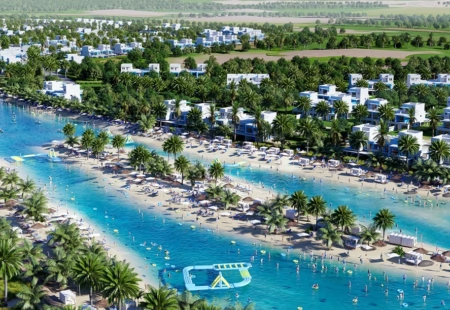
Abu Dhabi offers a mix of waterfront property, cultural hubs, and family-oriented communities. It combines strong governance with long-term urban planning.
For investors seeking capital growth and high rental yield in a stable environment, the capital presents a compelling case.
Final View – You Can Cansider
Abu Dhabi today shows many of the early signs that once defined Dubai’s recovery cycle. Prices remain relatively accessible. Supply growth is measured. Demand continues to rise with population and workforce expansion.
Will prices boom exactly like Dubai during COVID? Markets rarely repeat in the same way.
But the ingredients for strong growth are present. For investors looking at 2026 with a medium-term horizon, Abu Dhabi deserves serious attention.