-
Market Insights | Real Estate
Dubai vs Singapore: Why Chinese UHNWIs Are Choosing the UAE
A Clear Shift in Global Wealth Location – Dubai vs Singapore
Across Asia and the Middle East, a noticeable shift is taking place.
Chinese ultra-high-net-worth individuals are changing where they live, invest and base their long-term plans. For years, Singapore held that position almost by default. Today, that certainty has weakened.
Between 2024 and 2026, relocation decisions accelerated. Families who once viewed Singapore as the safest base began reassessing their options. In that process, the UAE moved from a secondary choice to a primary destination.
Dubai and Abu Dhabi now stand at the centre of this movement. They are no longer emerging wealth hubs. They are established ones.
The Numbers That Explain the Shift
In 2025, global wealth migration reached a turning point.
The UAE recorded an estimated inflow of 9,800 millionaires, the highest number worldwide. This figure alone placed the country at the top of the global wealth migration rankings.
Singapore, by comparison, attracted around 1,600 millionaires during the same year. More importantly, this represented a decline of nearly 50 percent compared with 2024.
Such a gap reflects more than preference. It signals a structural change in how wealthy families evaluate jurisdictions.
When capital moves at this scale, it reshapes markets, policies and long-term influence.
What Is Driving Chinese UHNWIs to Relocate
Chinese UHNWIs approach relocation with caution and long timelines. These decisions are rarely emotional. They are practical.
Families look for clarity. They want to know where they can live without uncertainty. They want to understand how their assets will be treated over decades, not years.
Residency stability matters. Predictable rules matter. Speed matters.
Many families are now prioritising places that allow them to plan across generations without repeated approvals or policy reversals. They also seek locations that allow easy movement of capital and people.
The UAE fits these needs with fewer obstacles than most global centres.
Singapore’s Changing Position
Singapore remains a strong financial centre with deep institutional credibility. However, recent policy shifts have changed how UHNW families assess its long-term suitability.
Permanent residency approvals have become increasingly competitive. On average, Singapore issues around 33,000 PRs each year, while demand continues to rise.
Reported approval rates have dropped to roughly 8.25 percent. Processing timelines have lengthened. For families planning succession, education, and multi-year investment structures, these delays introduce uncertainty.
At the same time, compliance requirements for family offices have increased. While oversight has improved, operational complexity has grown. Some families now see the environment as restrictive rather than supportive.
This does not mean Singapore is losing relevance. It means it is no longer the default choice.
Why the UAE Feels Different to UHNW Families
The UAE offers a contrasting experience. Its approach focuses on clarity, speed, and long-term commitment to global capital.
Residency pathways such as the Golden Visa provide five- and ten-year validity. Processing timelines are fast. Families can establish a stable base without years of waiting. Tax treatment remains simple. The UAE does not levy personal income tax. For UHNW families, this reduces complexity in wealth structuring, distributions, and inter-generational planning.
Foreign ownership rules also support control. In many sectors, families retain full ownership of their businesses and assets. This control matters when managing global portfolios. Perhaps most importantly, the system moves quickly. Company formation, licensing, and regulatory approvals happen without prolonged delays. Capital can be deployed without friction.
Dubai and Abu Dhabi as Complementary Wealth Centres
Dubai and Abu Dhabi now operate together as part of a single wealth ecosystem.
Dubai functions as the commercial and lifestyle centre. It offers international connectivity, a mature financial environment, and deep real estate markets. Entrepreneurs and founders often choose Dubai as their operating base.
Abu Dhabi provides institutional strength. Its regulatory frameworks support large funds, long-term capital, and structured family offices. Many families prefer Abu Dhabi for governance and oversight.
Rather than choosing one city, many UHNW families use both. Operations in Dubai. Capital management in Abu Dhabi.
Who Is Moving
The profile of relocating families is consistent.
Most are Chinese UHNWIs with significant operating businesses or investment portfolios. Many manage family offices. Others are technology founders or second-generation wealth holders.
Average investable assets often exceed USD 30 million per family. For some, portfolios are substantially larger. These families focus first on capital preservation. Growth matters, but security comes first. Lifestyle benefits support the decision but rarely lead it.
The Impact on UAE Real Estate
Wealth migration leaves a visible footprint in property markets. In the UAE, this impact is already clear.
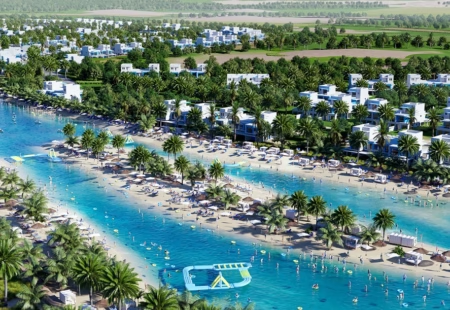
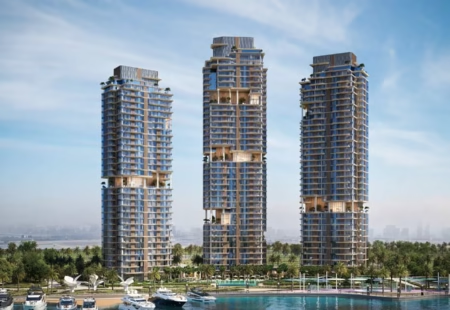
Demand has risen for prime residential assets, especially in locations that offer privacy, quality design, and long-term value. Waterfront properties, branded residences, and low-density villa communities attract strong interest. These buyers do not trade frequently. They hold assets longer. This creates stability and supports price resilience.
Commercial real estate also benefits. Family offices need offices. Funds need regulated spaces. This drives demand in financial districts and mixed-use zones. Over time, this type of capital deepens the market. It reduces volatility and supports measured growth.
A Practical Comparison: UAE vs Singapore
From a residency perspective, the UAE offers longer validity and faster processing. Singapore applies tighter quotas and longer timelines. From a tax perspective, the UAE offers a zero personal income tax environment. Singapore remains competitive but does not match this simplicity. For family offices, the UAE offers flexibility and speed. Singapore applies stricter approval standards.
In terms of space and cost, the UAE offers larger residential units and lower cost per square foot. Singapore faces space constraints and higher living costs. Capital mobility remains easier in the UAE, which prioritises openness and access.
What This Shift Means for Investors and Developers
For investors, this migration trend supports long-term demand rather than short-term speculation.
For developers, it rewards projects that prioritise quality, privacy, and clarity. UHNW buyers look for reliability more than novelty.
For service providers, demand grows for legal, advisory, and asset management services that support family offices and cross-border planning. The ecosystem strengthens as more capital anchors itself locally.
Looking Ahead to 2026 and Beyond
The drivers behind this shift remain in place. Residency frameworks in the UAE remain stable. Financial zones continue to mature. Real estate supply in premium segments remains controlled.
At the same time, global wealth mobility continues to rise. Families seek places that support flexibility and certainty. The UAE now meets those expectations at scale.
Conclusion
The movement of Chinese UHNWIs from Singapore to the UAE reflects deeper global change. It is not driven by short-term incentives. It is driven by structure.
Families want certainty. They want speed. They want clarity for the next generation. In 2025, the data confirms that the UAE provides these advantages more effectively than many traditional hubs.
Dubai and Abu Dhabi have moved beyond comparison. They now operate as primary centres of global wealth. For investors, developers, and advisors, this shift defines where capital will settle in the years ahead.